
Snowflake is a cloud-based data warehousing platform used for storing, processing, and analyzing large volumes of structured and semi-structured data.
It follows an OLAP (Online Analytical Processing) architecture, which is mainly designed for analytical reporting, business intelligence, and data analytics.
Snowflake supports cloud platforms such as:
- AWS
- Microsoft Azure
- Google Cloud Platform (GCP)
One of the major advantages of Snowflake is its separation of storage and compute, which allows users to scale storage and processing independently.
How Snowflake is Used in Real-Time Projects
In real-time data migration and analytics projects:
- Data is collected from multiple source systems such as:
- Oracle
- SQL Server
- PostgreSQL
- MySQL
- APIs
- CSV/JSON files
- Cloud storage systems
- The data is loaded into Snowflake using:
- ETL/ELT tools
- Pipelines
- AWS S3 buckets
- Snowpipe
- Informatica
- DBT
- Airflow
- Once the data is loaded, SQL is used to:
- Clean data
- Transform data
- Join tables
- Create business logic
- Build analytical models
- Snowflake processes both:
- Historical data
- Current/real-time data
- Finally, BI tools such as:
- Power BI
- Tableau
- Looker
Important Points to Add in Interview
Key Features of Snowflake
1. Cloud-Native Architecture
Snowflake is built completely for the cloud.
2. Separation of Compute and Storage
Storage and compute resources work independently.
3. Multi-Cluster Shared Data Architecture
Multiple users can access the same data without performance issues.
4. Scalability
Can scale up or down based on workload.
5. Supports Semi-Structured Data
Can handle:
- JSON
- Avro
- Parquet
- XML
6. High Performance
Uses automatic optimization and caching.
7. Security
Provides:
- Encryption
- Role-based access
- Data masking
- Secure sharing
8. Time Travel & Fail-safe
Allows recovery of historical data.
Formal Short Interview Version
Snowflake is a cloud-based data warehousing platform used for storing and analyzing large volumes of data. It follows OLAP architecture and supports structured as well as semi-structured data. Snowflake supports AWS, Azure, and GCP cloud platforms.
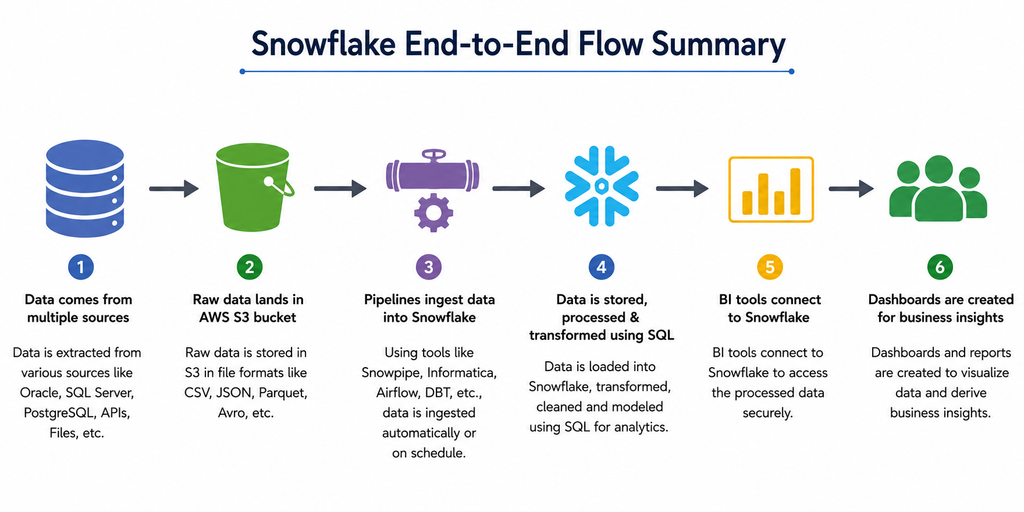
In real-time projects, data is migrated from multiple source systems like Oracle, SQL Server, PostgreSQL, APIs, and files into Snowflake using ETL pipelines, Snowpipe, or cloud storage such as AWS S3.
After loading the data, SQL transformations are performed for analytics and reporting purposes. Finally, BI tools like Power BI or Tableau are connected to Snowflake to create dashboards and business reports.
Snowflake provides features like scalability, separation of compute and storage, high performance, security, and support for real-time and historical data analysis.
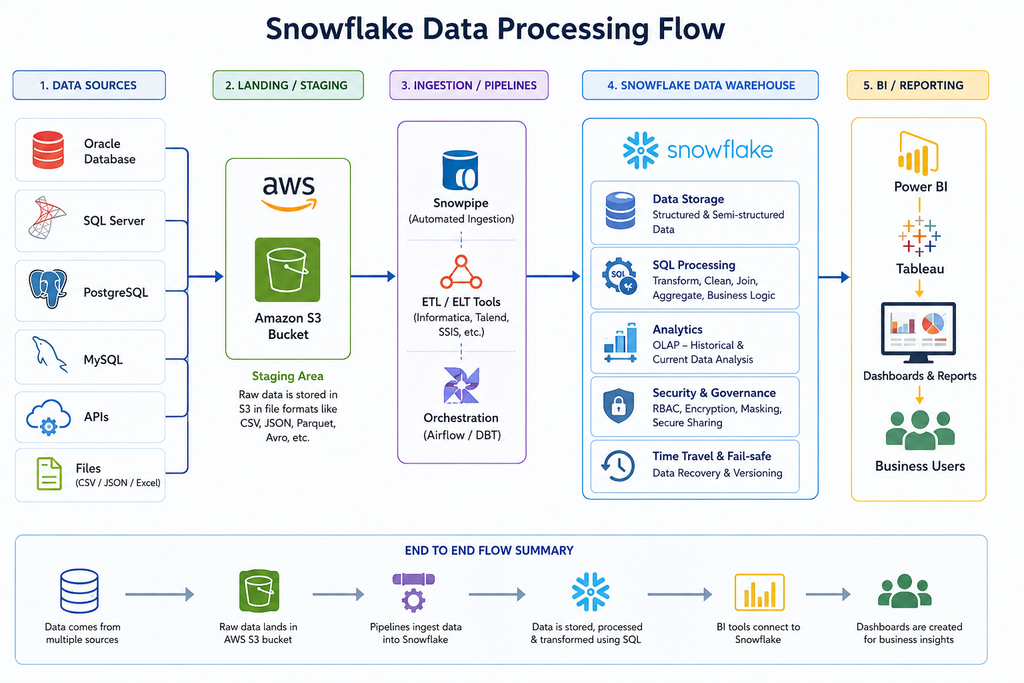
Snowflake Data Processing Flowchart
Source Systems
-------
Oracle
SQL Server
PostgreSQL
APIs / CSV / JSON
|
AWS S3 Bucket
(Staging Area)
|
ETL / Pipelines
-------
Snowpipe
Informatica
Airflow / DBT
|Snowflake
-------
Data Storage
SQL Processing
Transformations
Analytics
|
BI / Reporting
-------
Power BI
Tableau
Dashboards
01-09-2026